




One of the first questions people ask is, whats the best type or kind of Latex for a mattress? The answer depends on what you want the Latex to do, here is our guide to the two main Latex mattress manufacture methods.
There are two main methods of producing Latex sheeting. Talalay and Dunlop (also known as Dunlopillo due to the confusion with the brand). There are some differences in the manufacture and properties of the end product that you need to be aware of.
Talalay – Is created when liquid Latex is poured into special moulds which partially fills them. Then they are vacuum sealed and the air is removed, this makes the Latex expand and fully fill the mould. The Latex is then frozen at -30 degrees. Co2 gas is then blown through the mix which makes it harden and it is finally baked at 130 degrees to finish it. It is then washed to remove additives and solvents. Customers often ask – Why is talalay so expensive? This is because the manufacture of Talalay is limited by the size of the mould. Also the process by which is is baked is more expensive than the dunlop method. This often leads people to believing that ‘Talalay is the best type of latex’ or ‘Talalay is better than dunlop’. Which is quite confusing. Due to its higher price people have confused Talalay with being the best type of latex which isn’t always the case. Talalay is better for softer comfort layers, but you would need far more of it to get the same support you can get with dunlop latex. Thus the overall cost of a like for like mattress in Talalay would be higher as you would need more talalay to get the same support, granted the top comfort layers would be softer. There is also an argument that Talalay isn’t as robust as Dunlop latex as it is softer, but again by the time you’re looking at 100% natural latex the differences are minute.
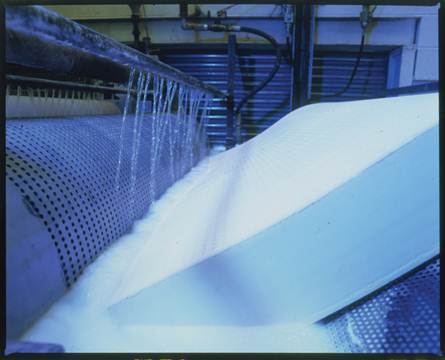
Dunlop Processed Latex - Liquid Latex is mixed with soaps and air to get the desired density. A gelation agent is added to turn it solid as it is poured onto a conveyor belt, or mould, and then vulcanised, baked, in an oven. Once baked it is then washed to remove soaps, additives and solvents. Then oven dried again on the conveyor belt and cut to the correct size. Dunlop is incredibly progressive in its comfort and can provide support with lower amounts of latex when compared to Talalay which reduces the cost to the consumer and depth of the overall mattress. Dunlop is also considered the more robust of the two types giving a slightly firmer feel to it compared to Talalay.
What is the difference between the manufacture methods of latex? - Another valid question which is shrouded in some mystery and personal preferences.
 Another good comparison is what’s the difference between bottled and tap water? To most there wont be any noticeable differences unless you have a super sensitive palette! Others will swear to know the difference and have their own preference. In a nutshell Talalay is a softer Latex than Dunlop, which is usually firmer with more progressive comfort and support. Talalay is the most expensive Latex type and is often a blend, with 100% Natural being rare.
With Latex the end product has the following differences for each method.
- Talalay is softer and can be more breathable
- Dunlop offers better progressive comfort, i.e. the deeper you go the firmer the feel so you won’t need as thicker core as a Talalay mattress, which is far softer, for the equivalent comfort.
- Talalay is the most expensive production process due to the methods described above. Due to this it has led to only being supplied to a select number of manufacturers who used to pay the premium for having this material. This has led to some people claiming that Talalay is therefore the highest quality as only a few use it.
- The Dunlop method offers a wider variety of products due to its manufacture method and it can be produced to almost any dimension. The energy usage is 4 times lower than Talalay. There is an argument that dunlop latex is more environmentally friendly than its Talalay equivalent.
- Talalay offers better breath-ability; though given how incredibly breathable Latex is this benefit maybe minimal in the mattress context.
- Dunlop is argued to be more durable and resilient than Talalay. Meaning that 100% Talalay isn’t as robust, due to its softness, compared to Dunlop. This is because Talalay is lighter by nature, less dense, than Dunlop so isn’t as durable. See our density guide here.
Our Latex is manufactured using the Dunlop method as this offers the best progressive comfort for a Latex mattress without having to pay premium amounts. We do offer a Talalay Latex topped pocket sprung mattress at John Ryan By Design but all our solid core Fusion Range mattresses are solid core Dunlop Latex. We only offer a 80% Natural 20% Synthetic blend and a 100% Natural Latex. Other retailers will use a 60% Natural 40% Synthetic blend as their top end ‘Natural’ offering, again you need to ask the right questions to find out. By the time you’re looking at 100% Natural latex the differences will be small and then it rests with your personal preference.
As always, we are providing you with the information you need to make an informed choice and not be misled or confused when choosing a Quality Natural Latex mattress.




Euanne
We cannot decide between the Fusion 80% natural vs 100% natural mattress topper. Can you please help? Thanks.
Hi Euanne, The difference between the two is subtle but important. The 100% is the highest quality latex you can buy whereas the 80% is still high quality but at a slightly lower price point due to the blend. The difference in feel will be minimal, but the longevity maybe slightly higher in the 100% natural.
To give an idea of comparison most shop bought latex is either 100% synthetic or 20% Natural / 80% synthetic.
I hope that helps make your decision easier! – Lee
Derrick
Hi, I’ve seen a second hand Dunlopillo 75 ‘Luxury Latex’ mattress for sale on Gumtree. I wondered if you could let me know what you think of it compared to your fusion latex range?
Derrick
HI Derrick, Firstly let me say that buying a second hand fully used mattress thats been used for some time, ie not a show bed or clearance mattress, does carry some risks, such as the bed being beyond its life, ie over 5-7 years also that someone has had the bed and will have compressed it for their body shape and weight.
With that aside the model you have mentioned is a one sided only mattress with a latex layer. Dunlopillo don’t give specifics on their blend of latex meaning I can’t adequately compare it to our Natural Latex models. From what I’ve seen Dunlopillo is a blend of latex ie synthetic, but have no specifics of the percentage blend.
I would state that this mattress no where near compares to our range as our fusion solid core latex mattresses are all double sided turnable mattresses. If you need any further advice please call us – Lee
Julie
I am thinking of buying a zen rejuvenate sk 2400 pocket sprung with a latex top but can’t seem to find out what sort of latex is in the top of the bed they say it’s natural with no details of how natural can you help with this kind regard Julie
Hi Julie, looking at the mattress specs there’s no mention of natural latex. From the details I’d say it was primarily synthetic latex, we have a very detailed section all on latex but in a nutshell unless a description of latex gives you the percentage blend you can’t accurately compare or measure it’s quality. We usually advise that if a model doesn’t specify it’s more than likely synthetic.
After all if it was natural you’d most certainly shout about it given natural latex’ superior quality! As for the Zen it also has a stitched on pillow top which we would never recommend due to the compression and sag issues we have also detailed. You could always get in touch with dreams and ask them if they can specify the blend or type of latex. If you find out I’ll happily advise further on this .
If you’re looking for that type of mattress we would recommend getting one with a removable topper which reduces the issue of compression and will provide a much more durable mattress. We have our Fusion Zero which is a high quality 80/20 natural to synthetic latex blend. I hope this helps Julie. Lee