




Mattress Comfort Zones: The good, the bad the confusing!!
 As the market for mattresses gets increasingly competitive and you, the savvy consumer, get wiser to what the jargon really means the retail sales machines crank it up a notch.
A recent development is the ‘Comfort zones’ benefit in mattresses. We believe these fall under three categories; the good, the bad and the confusing! First things first what is a comfort zone in a mattress?
What is a comfort zone? - This is a brilliant question and one which has little information in the way of an answer. A comfort zone in its purist term is when a mattress contains various tensions, densities, depths or firmness areas giving you a mattress that has a variety of zones within it.
There are however a number of methods of creating this, some good and some awful!
The Good: It has been practice in traditional pocket sprung mattresses for some time for premium mattress manufacturers to offer dual tension springs, or mattress zoning. This is to usually accommodate different weights in sleepers. This mattress zoning that makes perfect sense as it gives both sleeper their own preferred tension.
1- Dual tensions springs: Different tensions of springs on each side of the mattress. For example a lighter and heavy bed sleeper together, this is done by a manufacturer making a handmade pocket sprung mattress with two different tensions, these tensions can only be one grade up or down from each other ie soft and medium or medium and firm, never soft and firm as this would cause a ridge or height difference
2- Zip and link mattresses: Two mattresses zipped and linked together. Which can be combined provided the mattress is the same construction but with different springs, this can be soft and firm or any combination to suit two different sleepers
Both of these features are valid, demonstrable and can be of benefit to the sleeper. John Ryan By Design has an excellent range of dual tension and zip and link mattresses if this is the type of zoning you require.
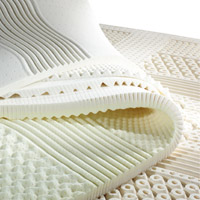 3 – Perforated Latex: In premium solid core Latex mattresses ‘comfort zones’ are used to provide different tensions in the same piece of Latex foam. This is achieved by varying the size of the perforations in the Latex. For example a 3 comfort zone solid core Latex mattress will have 3 areas where the perforations either increase or decrease resulting in either a softer or firmer feel in that zone.
At John Ryan Contemporary we offer the highest quality Latex with 7 comfort zones. This provides you with 7 different pressure relieving areas firmer where pressure points on the body are. The 7 zones cover the following areas. head, shoulders, back, hips, knees, legs and ankles. It allows for more pressure relief and comfort.
The Bad: Here is an experience of bad ‘comfort zones’ or as we like to call them…The Frankenstein Mattress.
 Comfort zones are sometimes used when a mattress is made up of a number of materials, stuck together in a Frankenstein like fashion! You may have heard of perimeter support which is used in a number of traditional mattresses. Where a firmer spring is used nearer the edge so you dont roll off easily. Yet in foams the density of the foam should be consistent so rolling off is minimised. Terms like perimeter support in Latex beds is often used to combine cheaper Memory Foam to a Latex mattress around the edge to give more support. Which we know from our post on perimeter support is unnecessary. We believe this is to reduce the amount a manufacturer has to spend on Latex whilst being able to sell the mattress as ‘Latex core’. The truth is only solid Latex core guarantees a full Latex mattress.We only sell solid core Latex. No other foams around the edges or such. In Memory and Hybrid mattresses the comfort zones sometimes are different densities of foams that are used together to give different tensions on the mattress. We’re sure you are now scratching your head saying ‘isn’t this a bit of a swizz?’.
The difficulty is Memory and Hybrid foams don’t need necessarily need comfort zones because the benefit of the material used is that it has a consistent density in one piece. We need to mention foam encapsulated pocket springs here (FEPS) these really do need perimeter support or foam edging to enable them to remain in once consistent piece. FEPS should be excluded from the perimeter support argument here. Think of it as a foam box to encase a row of springs so they stay uniform. Our shop cut aways of the pocket-flex mattress will show you this.
With the exclusion of FEPs all other Memory / Hybrid and Latex foam perimeter support should be looked at with some trepidation. Confused? It really is starting to sound like a horror movie! Let’s try and give a more relaxed example.
Using the cake analogy, if you cut different cakes together and then stuck them together you would get a variety of flavours and textures, which to some maybe appealing. The downside is there would be no consistency overall and each type of cake reacts differently to the palette. In mattresses the same rule applies, the benefits of a foam mattress should be getting the right consistent density for the weight and preference of the sleeper.
Memory, Hybrid and Latex foams main benefit is it reacts and moulds, albeit in different ways, to the body of the sleeper. Now imagine if you put a number of different densities together and foams you would end up with a very mixed bag in terms of consistency. Moving on to the no turn issue in mattresses, you can imagine that on a one sided mattress this then multiplies the issue around sagging and wear. If foams are cut and adhered to other foams we class this as the ‘Frankenstein mattress’.
The Confusing: Let me use a recent example of a large well established homeware store in the UK. Now we are the chivalrous sort so we won’t name names as we are critiquing the sales jargon not the seller here. They advertise a Kingsize pocket sprung mattress, granted this is not a Memory Foam mattress, which contains 7 comfort zones, further more they have a range of mattresses with 5 to 9 comfort zones.
The Kingsize pocket sprung is the one we have direct experience of. Their brochure and retail stores clearly label this as a benefit of the mattress. All so far so good. It falls apart when you ask them the basic question of ‘what is a comfort zone?’. Then the tumble weed approaches and an eerie silence descends (apologies we may have been reading a horror novel late last night) and the staff cannot tell you what these are. At best you will get the following ‘they are zones in the mattress made up of different comfort levels’. It’s all getting very twilight zone as they awkwardly answer you and the shop goes silent.
Confused? You and me both. A further query about what these are made of and you get a response of either ‘its different materials’ or ‘I’m not sure’. This is when my investigative skills kicked in and out came the trilby. Without going into excessive details would you believe that we have had 7 email responses from the company and their product enquiry team all stating they don’t know what these comfort zones are?
The line of enquiry was started in June 2013 and still we have no answer apart from ‘we don’t know’. That they will have to ask the manufacturer, who also doesn’t seem to be able to articulate this either? I think the example is demonstrated here about sales jargon and unclear benefits.
Our recommendation: Lets keep things simple. The comfort zones we have tested and approve are
Traditional Mattresses – Zip and link & Dual Tension mattresses
Latex – Solid core Latex with comfort zones via perforations
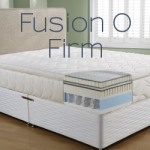
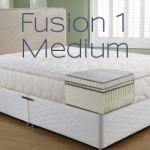
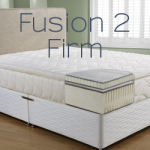
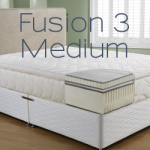
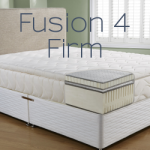
Any thing else we would steer well clear of!




Charles
Hello,
Do you do any of the your latex mattresses in 90 x 200 size? I would need two of them?
Are all your latex mattresses only using Dunlop process? Or do you have some using Talalay?
Do your latex mattresses have comfort zones?
What are the benefits of having a pocket-sprung lower layer, over having a Dunlop latex lower layer, or an HD foam lower layer? Coolnes, the ability to sleep-on (not in) and quietness are important to me.
Many thanks, Charles
Hi Charles,
We can create two mattress of that size if you so wish under our bespoke service.
We only use dunlop latex in our solid core ‘fusion’ range as this is the most progressive. We do use a talalay layer in the Origins Latex in our traditional range but this is a one sided traditional mattress rather than a contemporary two sided solid core latex mattress.
Our mattresses do use comfort zones, 7 of them, but I’ve written a post on why this is never used as a selling point as its really quite a small benefit in latex.
Pocket sprung beds are usually cooler but are a lot firmer when matched with latex. HD foam is the warmest heat retentive layer making a mattress warmer than a traditional mattress. Having a solid core latex mattress i.e. one piece of dunlop latex, is the most breathable when compared to HD foam and is two sided. So you need to ascertain which benefit is the most important to you. Hope that helps. Lee
Pam
Hi there I am 6’2 and approx 13 1/2 stone I sleep on my side but I have a bad hip (Bursitis) and back from years of running I find hard mattresses very uncomfortable
Thanks Regards.
We have a number of softer mattresses and medium that would be suitable for your weight and issues. It would be helpful if you could let me know what kind of tension your looking for specifically, i.e. softer vs medium or if you don’t know thats fine. I would need to know your rough budget to help further. Latex is the best material for progressive comfort and the issues your experiencing, see our Fusion 1 for example of a medium latex mattress ideal for your bodyweight, but if your budgets can’t stretch to latex then maybe one of the Hybrid mattresses would be suitable, such as the Hybrid 4. Please give us a call to discuss.
Sharon
Hi,
I’m 9 stone and my husband is 11 stone and we’ve had a firm bed for years. It’s now at the end of its life and has started to dip and feel lumpy.
Can you please advise on which of your solid core latex mattresses you would recommend for this? I rread somewhere on your site that people confuse a supportive mattress with a firm mattress. Can you explain more, everyone in the stores has told us to go for a firm mattress if we want support!
Should we be looking at firm or would your advice be for something else?! We are both getting the old tired aches and pains and want to get a quality mattress that will last us! – Sharon
Hi Sharon, The old mantra of ‘you need a firm mattress if you want a supportive mattress’ is quite misleading. Let me try and explain the difference between support and firmness. Think of support as cradling and holding a person at a certain depth in the bed dependant on their weight. Firm support would for examples hold you higher up the bed with less give vs a softer support which allows you to sink in further but still supports you. An 18 stone man/woman would probably not want a soft support bed as they would sink too much in comparison to the support, like wise an 8 stone man/woman probably wouldn’t want a firm support unit as they wouldn’t sink enough.
Therefore firmness and support are not mutually exclusive. They are not necessarily the same thing! What I always say to 90% of customers is that what you should be looking for is a bed that supports your weight, in your case a firm spring unit would be overkill, but has a comfort layer that allows a degree of sink or comfort in the bed. In most cases you neither want a solid brick slab of a mattress or a sinking bowl of custard!! You want a mix of support and comfort.
For your weights I would advise you look at the medium mattress, this will allow the latex to sink slightly before the support kicks in. If you look at the firm, I think the comfort layer will be too firm for you leaving only firm support. Obviously some people like this but I’ve found them few and far between and especially when they are trying to avoid aches, pains and pressure points!! Therefore I’d initially advise the medium solid core latex Fusion 1 or 3 for you to look at. Lee
William Debono
Hi,
Been looking to replace my mattress best i liked Silent night Ashridge,and Slumberland Penzanz both firm with firm edges,got to have firm edges,now can you please recommend one from your list that got the same spec similar to these 2 i mentioned.Thanks.
Regards, Mr Debono.
Hi William, Thanks for your query.
Perimeter support in a contemporary non sprung foam bed is a tricky one if you want a firm edge foam bed then what you are looking for is a firm foam pocket sprung bed. You will find that all foam and latex beds have a softer edge than say a traditional bed. The reason for this is that a quality foam or latex bed should be consistent. Ie the same density in the middle as the edge. For some people this gives the illusion of a soft edge. In reality to get a true firm edge would mean compromising the foam or components, ie adding cheaper denser foam to the edge, This will then degrade say at a different, quicker, rate to the latex or foam leaving undulations or bumps. That is why we never do this.
In a traditional bed the perimeter support or edging stops sagging of the edges as the components, say natural wool move and settle over time. The edge or perimeter support reduce this and a quality traditional mattress should have this. It ensure the bed stays robust given all the springs contained within.
Based on the models you have looked at I would recommend our Origins Latex which has a firm feel to it but with the benefits of latex.
I hope that helps – Lee (John Ryan Contemporary)