




One of the frequently asked questions is ‘Are your beds suitable for slatted bases?’. The quick answer is, not without some modification. This is not to say that they can’t be used to provide the nights sleep you expect, its just that unfortunately slatted bases are usually not constructed in a robust enough manner for foam mattresses, which need a firm consistent base. Foam mattresses ideally require a platform top or sprung edged base to provide the stated tension, ensure longevity and avoid dips or damage.
There are two types of slatted bed base.
- Sprung Slats
- Solid Slats
Sprung Slats: This is where the slats are humped or arched. You may have heard of ‘the hump back bridge’ effect where the mattress develops a central dip due to this. This is where the pressure from the arch is too firm for the mattress. The middle of 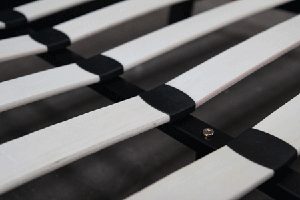 the slats is the lowest point and the foam conforms to this shape. Whilst a solid quality pocket sprung traditional bed can sometimes overcome this, a foam beds sole purpose it to mould and contort to the sleeper and surface. Therefore even the highest quality foam and Latex mattresses will not just mould to the sleeper on top, but also the gaps and arches beneath. This is where unidentified dips or sags come from. It is due to the pressure from the slats and hump to the mattress. Sprung slats aim to emulate a pocket sprung edge but fall short of providing the benefits. Our advice is to choose a pocket sprung edge rather than sprung slats.
Solid Slats: Lower priced bed frames tend to use solid slats. The issue is to cut costs they provide the bare minimum slats to  rest the mattress on. We have seen Kingsize beds with 4-5 inches between the slats, which is far too big a gap. These gaps allow the mattress to conform to the gap and the excess pressure it causes allows them to ‘dip’ through the gap. This is not to say the mattress has dipped, more it has simply followed the shape of the base. We sometimes refer to this as ‘falling through’.
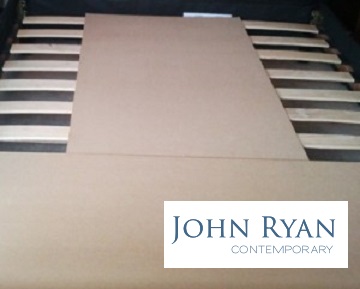
What can I do to prevent issues with slats?: Our advice is always to board over the slats, if possible. If the base has sprung slats we would advise that the horizontal slats are boarded over. We advise either MDF or plywood to do this. Pegboard can also be used to aid ventilation, though bear in mind the weight of the mattress and what it is resting on. If the mattress feels and looks too heavy for the material you want to board the base in it probably is. Also don’t forget to consider the weight with you on it as well! The image shown is an example of how to do this, particularly on sprung slats to avoid the ‘humpback bridge effect’.
 What’s the ideal base for a foam mattress?: The best answer is to go for a platform or sprung edge divan ideally. This ensures a consistent surface and removes the issue of slats causing dipping or damage to your mattress. Whilst a nice looking bed frame is a consideration when buying a new bed, you also have to weigh this up against the impact of certain slatted bed frames. Particularly against your mattresses longevity, comfort and consistency.
Check out our range of mattresses here or visit our traditional John Ryan By Design range which are suitable for slats here.




Karen
Hi,
I am really hoping that you can help me – I live in Canada and did not buy one of your mattresses, but am desperate for advice and came across your article on slatted bases and foam mattresses (http://www.johnryancontemporary.co.uk/mattress-construction/slatted-bases-and-foam-mattresses/)
I have a king size bed frame with sprung slats and a foam mattress and I am finding that if I kneel on the bed (or stand up on the mattress to open the window) the slats will break. Also, the mattress feels so much softer than it did in the store because of the base.
I saw your guide to boarding over the slats and the picture and I have a question… In the picture the sides of the slats are not covered (i.e. there is a board at the top and down the centre so that it is in the shape of a ‘T’. Is this to allow the slats to move or should I be covering the slats completely with plywood. Also, would you use one sheet or a few?
Thanks very much in advance for you advice!
Hi Karen.
Thanks for your email. The picture is just an example so you can see where the slats are in relation to the boards.
Providing you board over the base to bridge the central bar (where it dips down) it doesn’t matter whether you use the the diagram as shown or entirely board over the slats. If you want to ensure complete ventilation, ie if your not regularly turning or flipping your mattress, where possible, you can use pegboard which has tiny circular holes cut out to reduce chances of condensation getting trapped etc.
I personally don’t think the softness of your mattress is unduly due to your base, although I can’t be entirely sure why the model in the store felt different (firmer) to the model you received. Furthermore, if you are standing on one are of the mattress – and there is insufficient mattress (ie a thin mattress) then the pressure on the slats will cause them to break as you describe. I do think the boarding out of your base will spread the load more evenly and should help.
Hope that helps Karen. Any more questions just give us a call. Lee
ian walker
ive got an £800 slay slatted base from john lewis. What matress type do I need for this base also the base seems to bump up on center beam. Should I take legs off the beam to make it a bit more flexible?
Hi Ian, You can in theory put any mattress on this, providing you board over it if its a foam or latex mattress. You can see more on slatted bases here. If you can give us a call with your body weight I can help advise on a suitable mattress. I wouldn’t advise taking the legs off the centre beam as they are there for stability and it may put undue strain on your slats. Thanks – Lee
James H
Hi,
I recently purchased your Origins Pocket 1500 mattress and I have a solid wood bed with solid, flat slats which are spaced around 6cm apart.
As this isn’t a memory foam mattress and the gap between the slats is small would you still recommend boarding the bed base? Would putting an old duvet over the slats help? Still do both?
I love the new mattress and just want to make sure I take the best care of it.
Thanks a lot,
James
Hi James, we recommend that if the slats are more than 2cm apart that you do board over them. This will help give the mattress a more consistent surface to work on. It will also help keep your mattress in tip top condition! Hope that helps James- Lee
Dan
I am interested in one of your mattresses (the Fusion 3 100% Natural Latex Medium) but I am not clear if the base will make any difference to the overall comfort? I would like to use it with my existing wooden bed base. Could you please advise if there would be a noticeable difference between using this mattress on top of an old wooden base (with some flex in it) vs one of your bases
Thanks
Hi Dan, The bases we sell alongside the fusion mattress range are platform top divans. This provides a consistent solid surface for the mattress, unlike slats and other wooden bases. The mattress tensions have been tested and selected using a platform top divan. A sprung edge divan for example would soften the over all feel of the bed so would change it slightly. Some argue that sprung edge divans take a mattress to the next level of comfort in adding another spring layer, this is of course personal preference! Sprung edge divans are more expensive and can out price some customers so we offer both options.
Can you explain further what you mean by a wooden base with some flex, sprung slats perhaps? If the base is sound and consistent then I can see no problem in using it, if it is slatted I would definitely recommend boarding over the slats Dan.
If you need any further information please give us a call. Lee
sion
Hi there my girlfriend and I have just bought a new bedframe (sprung slatted) and decadance mattress from bensons for beds… we previously had a divan base with memory foam mattress. We found that on the old bed we were often waking with a sore back. It was about 8yrs old. So we bought the new bed and mattress and found we are having the same problem.. when we tried the mattress in the store it was on a divan base and felt comfy. We were told that there is no difference on slatted base. We are away to try the plywood base today.
Hi Sion, There definitely is difference between a slatted base and a say sprung divan base. A slatted base will make a mattress firmer than say a sprung edged divan base, this is because the mattress is doing all of the work. The base is firm and so theres no give in it. We always recommend you try a mattress on both slatted and a sprung edge if you want to feel the subtle difference.
Even sprung slats will be firmer than a sprung edge divan and you also get the issue of the ‘humpback bridge’ effect in some cases. You are wise to board over the slats to stop dips and sinks in your mattress but it won’t soften the mattress. I would recommend that if you’re still having issues you give bensons beds a call as it sounds like you may have too firm a mattress. Even though the decadence mattress is listed as a medium tension mattress, it depends on your weight and preference. A medium tension to some can be a firm feeling mattress to others! If you can provide us with more specifics such as height and weight we maybe able to help further over the phone. Thanks. Lee
mel
Hi,
I have just bought a crystal t.v. bed and the base is slatted. the gaps in between are about 9cm. I have just ordered a sealy mattress 2400 alabama. Would this be ok for this bed if I was to board it like you say ?
Hi Mel, I would always recommend boarding over a slatted base because for the cost of a few pounds you can help prevent a foam or foam based mattress from taking on the shape of the slats and thus potentially dipping or sagging. The alabama 2400 from Sealey is a mix of innegetic latex, we have written about this kind of latex here, a pillow top and is a one sided no turn mattress. We have written a detailed article on why we don’t rate pillow top mattresses such as the alabama detailing the failure potential of the pillowtop. We however always say if the bed is comfortable then thats all that matters, it just maybe something to bear in mind that you may want to rotate the mattress more often to reduce the wear of the pillowtop. Hope that helps Mel. Lee
cole g
I have a set of sprung bed slats for my king bed. I purchases a plush mattress and felt it was dipping very slightly in the middle already. I believe this is from the curved bed slats not flattening out when I sleep on it. It gets worse when sleeping with my partner, I tend to be pulled towards the middle of the bed.
Would it be better to return the slats and purchase flat slats? Or keep the curved slats and layer a peice of plywood over that extends to the top of each arch as shown in your picture? I heard that the curved bed slats are better and more durable and will prolong the life of the mattress. Also if the playwood route is the best, what thickness of plywood is reasonable? I am 180lbs and my partner is 145lbs.
Thanks
Hi Cole, If you are suffering dips in your mattress from slats then I would advise you board over either type of slats. If you want to replace the sprung curved bed slats for flat ones it maybe easier to board but either way it will help improve the consistency of the base for your mattress. To be sure I’d replace the slats for flat ones and board then you have a definite flat consistent base.
As for the the depth of the ply either 4-6mm should be fine. Use your own judgement to see if the board feels robust enough. You can also use pegboard if its easier to get hold of. Just remember that the aim to to even out the surface allowing the mattress to rest of a consistent surface so it can’t dip or sag to spaces or undulations in the slats. Lee
Jay
Hi John/Ryan
I have placed MDF pieces of two across the bed sprung slats covering the entire slats… Is this ok or should it be placed as you have placed them?
Thanks
Hi Jay, That should be fine, we use that picture as a demonstration as the minimum you can apply to get a consistent base for your mattress. It sounds like you have covered the slats appropriately. Lee
Jay
Hi Lee
Thanks for your response, its great, cheers.
I posted this earlier in the week would be great if you can help?
I had a Sealy royal ortho posturepedic luxury deluxe 8 years old no issues, developing a dip after duration decided to select the bensons regal back care, after 4 weeks developing a dip causing much back ache.
Following my complaint to bensons, I can re-select or have a replacement.
I’ve had no issues with sealy’s first purchase until recently. I have viewed and tested a a backcare ultima, apparently made by myers. Pocket sprung supposed to be better.
I have also viewed online a sealy millionaire ortho posturepedic.
I am not familiar with dipping and would like to have a mattress that lasts without dips after 4 weeks and poor settlement.
What can you advise to help me get a mattress that wont dip and is like my previous model with comfort and lastability.
I am weigh about 13/14st
Regards
Jay
Hi Jay,
It’s strange given the firmness of both the mattresses you have listed, the Bensons Regal BackCare and Sealy Millionaire Ortho Posturepedic that you’re getting dipping and sagging so soon. Both of these mattresses are very firm in terms of comfort levels and support. We have an article which explains the difference between settlement in a mattress and a true dip. I’m mindful that the dip you mention is actually settlement in the mattress Jay. Either that or the mattress is faulty, but it does seem so strange in my experience for this to happen so soon. That said not impossible!!
As for the back pain a number of people were told once upon a time that a firm bed is the best cure for a bad back. This is completely wrong, whats ‘helpful’ (there is no miracle cure and no one should advertise such) with any sort of back or hip issue is a supportive bed which is comfortable. The key is the comfort layers on top of the support. It’s the mix of support and comfort you need to find. It looks like this model has too much support and not enough comfort Jay.
Given the firmness of the mattresses and the price point I wouldn’t recommend any of our beds as an alternative. I also am not sure what I would advise you to choose for that budget. In all honesty I’d choose a firm foam mattress with a softer memory or hybrid foam layer to help with the back issues. Alternatively to that I’d advise a firm bed but with a softer topper to place on the bed to help resolve your issue.
Thanks – Lee
Jenny
Hi, I have bought a tempur cloud mattress from Dreams a few weeks ago, its the cloud 22 deluxe I believe. I have a slatted base but have noticed the bed has started to sag and dip in places? Could this be down to the base or has the mattress failed? Please can you help?!
Hi Jenny, Ideally the best base for a memory , hybrid or latex foam mattress is a platform top divan or platform top alternative. This is because foam will start to mould and take the shape of the surface it is placed on so it you have a slatted base then you run the risk of the foam confirming to the slats and spaces in between. This leads to lumps and what looks like sagging. I very much doubt the Tempur cloud will have sagged in two weeks, that said I’d try to board over the slats and if the problem still occurs get back in touch with Dreams- Lee (John Ryan Contemporary)