




Latex is a premium solid core mattress material. Latex offers superior comfort and durability when compared to Memory Foam and other mattress foams. Further more its incredibly durable with some examples of Latex beds being 40 years + in age and still offering support and comfort! Latex is a derivative of the rubber tree and, in its true form, is the premium natural foam alternative. This in turn makes it a more expensive material. Latex is not heat retentive like some other foams and has a rapid response rate; this means it returns to its original shape very quickly. It is often classed as the top end mattress foam material.
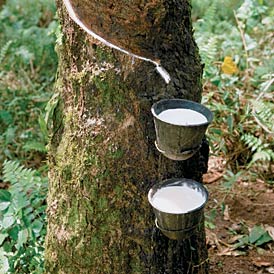 Latex is by nature hypo-allergenic, anti-microbial and dust-mite resistant. With the exception of Latex allergies it is a prime choice for those who have sensitive skin or non-Latex allergies.
The key to quality Latex lies in its construction method which will usually be anything from completely synthetic, chemically reproduced Latex equivalent, to 100% Natural solid Latex. The latter being the premium material.
Tricks of the trade: One key fact to bear in mind is the depth of Latex and construction method used. As Latex becomes more and more popular bed retailers are including it in their ranges, but not always for your advantage. Due to the high price tag adding a Latex component can allow retailers to increase their prices without necessarily increasing the benefits to you over other foams.
For example a retailer may have a ‘Latex’ bed in their catalogue. You may believe that this brings you the full benefits of Latex. Upon further investigation you find it is a 2cm top layer of completely Synthetic Latex, sitting on top of Memory Foam or a pocket spring unit. Our previous posts on Memory Foam have established that any layer of foams less than 5cm have no practical use as the accepted compression amount is 2cm on most mattresses. This means that when the mattress compresses, which all foams will and this is natural, your Latex 2cm layer would become completely unusable. Therefore you would have been better buying a Memory Foam mattress or cheaper equivalent with 5cm of foam! Although the mattress contains a premium material the application of it completely removes the benefit. Though you’re still left paying the price tag for it. Confusing isn’t it.
Another example is where a manufacturer claims their bed is Latex when in reality it only contains partial Latex, especially in mattresses that have perimeter support, where cheaper foams are used around the edges to firm up the bed. So although it contains Latex again its not a consistent application of Latex. Other sales tactics will claim Latex filled toppers, again which are 2cm or use 100% Synthetic Latex rather than Natural Latex. Some even contain only Latex byproduct materials, which could be shredded or mixed with other fibers! The one lesson here is not all Latex is the same and you need to apply the same rules of depth, density, quality to your list of must know questions!
Manufacturers may claim 100% Latex, implying its 100% Natural but this is false. The ‘100% Latex’ label usually is 100% Synthetic so make sure you ask the right questions. Again the retailers version of ‘Natural’ Latex is usually 60% Natural and 40% Synthetic, at best! We have also found Natural Latex mattresses that are only 20% Natural Latex and 80% Synthetic!!
Stop the confusion!: All of our solid Latex beds however are solid core Latex, so the confusion can end here. We only offer two types; An 80% Natural 20% Synthetic blend and a 100% Natural Latex variety. They can be turned rotated and flipped like a traditional mattress. We only recommend solid core as its consistent and so you know exactly what you’re getting for your money, no hidden surprises!
You may have guessed by now that there is no one standard type of Latex and there are many different guises that a Latex label may hide! Read on to get better acquainted.
Our Latex Range Below:




Martin
Hi,
My partner weighs about 55kg, sleeps on her side and the current mattress mis-aligns her spine causing back pain. She needs a fairly soft mattress.
With past experience I’m reluctant to go for a memory foam or PU foam mattress. Are any of your latex mattresses soft enough?
Also – do you do zip-link mattresses in latex?
Hi Martin,
The softest latex we do is a medium density 70kg, that said latex is incredibly progressive so tends to be soft at first before the support kicks in. We also match our core mattresses with a matching toper which does help provide a softer top layer. If you wanted a hybrid foam mattress we do a very soft laygel mattress, a synthetic latex equivalent, but if you’re wanting to avoid synthetics then latex would be the option. Its a tricky one because it depends on exactly how soft you need the mattress to be. Latex is excellent at accommodating a variety of weights and giving enough sink before support.
We don’t do zip and links in the contemporary range due to the weight and flexibility of the beds. You would need really thick covers to enable the zip and link to be firmly held together which conversely would reduce the feel of the foam mattress.
If you want to discuss further please call us on 0161 945 3757. Thanks – Lee
Comment via Email
What are the differences between the 80/20 latex and the 100% latex as they appear to be very similar?
The differences are usually slight to most people. Such as 100% natural is slightly softer, slightly more breathable and slightly more natural! I always use the comparison of a decent wine vs a fine wine. To some the difference is noticeable, but to most palates they are very similar. There is an argument 100% natural latex is more durable in the long term, but by the time you get to 80% and above you’re already in the serious high quality zone! In a nutshell 100% natural is the best quality you can get and as soon as you introduce synthetic you start to water down and dilute that quality. Lee