




When you unzip a Latex mattress you will no doubt see lots of tiny holes or perforations. This is not because your manufacturer is ripping you off, but because these perforations are the only way the manufacture process can get consistent heat flow through the Latex when baking it.
These holes are caused by pins which allow the Latex to be cured consistently, like baking a cake and making sure the middle isn’t all goopy inside. It also ended up having the natural benefit of increasing airflow hence making a Latex mattress far cooler than Memory Foam or equivalent!
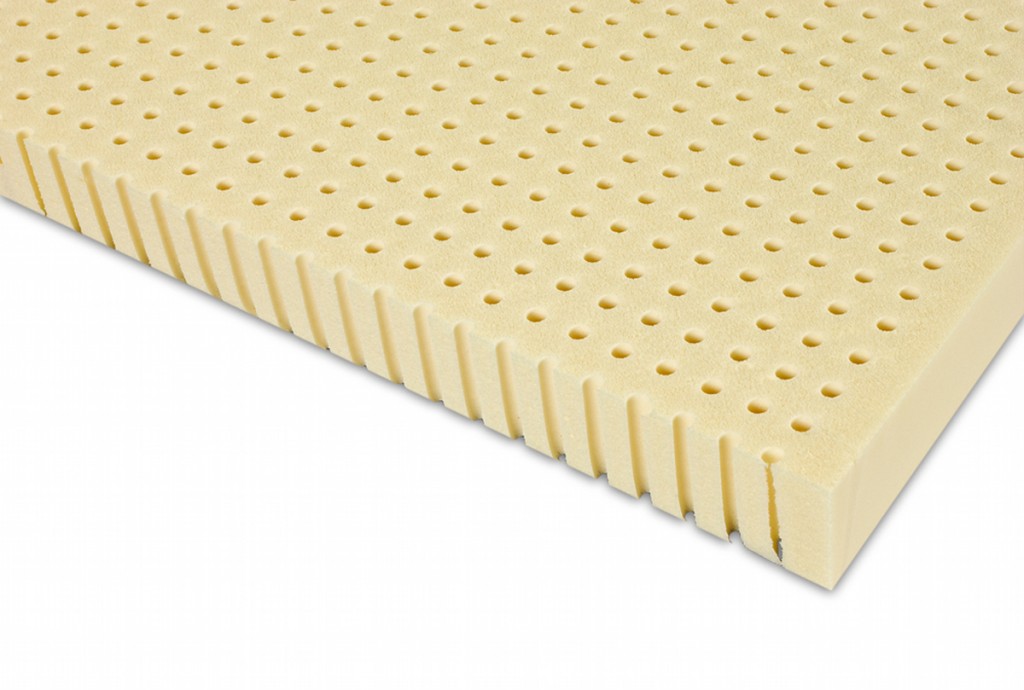
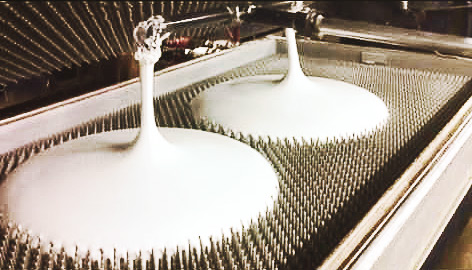
It is important to note that the perforations don’t necessarily go all the way through the latex, especially with our deep cores. This is no cause for concern as the perforations are there as part of the manufacture process and not intended to always perforate the entire depth of the mattress. With a topper, ie a shallower depth of latex, you may see the perforations all the way through but with a deep core say 18cm they may only go partially through. Here is an example of the process with Talalay Latex where rods are used which lead to perforations. In the manufacture of dunlop latex this would be a larger conveyor belt with rods that cure and bake the Latex.
Perimeter support – Some brands will brand a Latex mattress as having perimeter support as a benefit. With quality Natural Latex, like the models we offer, you shouldn’t need perimeter support. All this means is that another type of material, usually a dense cheaper foam, is used around the edge, reducing the amount of Latex and firming up the edges. A quality Latex mattress should never need this.
Our Latex Range Below:




Jen
I am very impressed by the information on your website. I suffer with back pain and have come to the conclusion that i would like to try a latex mattress. I am impressed with the fusion 1 and 2 as i like the fact that they are fully flippable, because my current mattress is worn and sagging after 4 years, and being able to flip it would have prolonged the comfort and life of it. I weigh just under 14 stone and usually prefer a medium/firm mattress. I am unsure whether to go for the fusion 1, which may be edging towards medium soft for someone of my weight or the fusion 2 which i am concerned may be too firm. Which would you recommend? Hope you can help.
Regards,
My guidance would be that our firm latex mattress is probably better for you given the progressive sink of latex. The firm range is topped with medium feel toppers so hopefully this will give you the best of both worlds, medium top layer comfort but with a firmer support layer. I hope that helps. It’s hard to say exactly because everyones firmness is subjective!
Jennifer
Hello!
As promised, here are photos of my existing mattress, the Dunlopillo Firmrest. I am seeking an identical (in feel, firmness, construction, materials) if you can supply it.
The mattress came with instructions that it did not need turning, and the reverse is different than the top. Thus it must have a comfort layer, but you can confirm this, please.
Best,
Jennifer
P.S. Thank you for your help yesterday and once again, your website is very informative.
Hi Jennifer, Glad you found our chat helpful.
Looking at the firmest latex and foam mattress in more detail yesterday in our archive I’ve uncovered its a foam and latex mattress, not solid core latex. So none of our models will feel identical as they are a far superior construction method.
For example the firmest has a firm foam base and sides to give perimeter support. We don’t construct our mattresses with perimeter support as we find that this is a shortfall on these kinds of mattresses. Introducing synthetic foam and natural latex is counter productive to the natural materials of latex. This does mean that the edges are quite soft on a solid core latex mattress and this is something you must bare in mind Jennifer.
We do a firm Fusion 2 or 4 is a firm 80kg solid core latex mattress. I can’t guarantee its identical to the firmest given they have different construction methods. If it helps please give us a call to discuss. Lee
If you can for now tell me which of the two mattresses you have mentioned have the firmest support, the least softness at the edges, and the greatest breathability, that would be great.
I am stuck having to put the new mattress on slatted wooden boards with a a 1.5 inch gap, and don’t know how this will affect those soft edges….
Glad you found our chat helpful.
Looking at the firmest in more detail yesterday in our archive I’ve uncovered its a foam and latex mattress, not solid core latex. So none of our models will feel identical as they are a far superior construction method.
For example the firmest has a firm foam base and sides to give perimeter support. We don’t construct our mattresses with perimeter support as we find that this is a shortfall on these kinds of mattresses. Introducing synthetic foam and natural latex is counter productive to the natural materials of latex. This does mean that the edges are quite soft on a solid core latex mattress and this is something you must bare in mind Jennifer.
We do a firm Fusion 2 or 4 is a firm 80kg solid core latex mattress I can’t guarantee its identical to the firmest given they have different construction methods.
Hello,
I have now read your email and revisited your website, and am still pondering what your suggested mattresses will feel like. So I took myself off to Bentalls department store in Kingston and John Lewis.
I found two mattresses that almost work for me, as the seem quite firm:
1. Hypnos Special 1400 Ortho Mattress
2. Relyon Orthopocket Extreme 1500.
Following are the materials for each one. My questions are:
A. Which of the mattresses that you have mentioned to me are as firm or firmer than these two (above)?
B. Which of the materials (including your own) are most breathable?
I will be placing the mattress on a solid slatted wood surface. The slats run top to bottom of the bed, and are less than 6cm apart.
Again, I need a very firm feel for two people — one who weighs 10 stone and one who weighs 12 stone.
The Hypnos (above):
— Reactive Pocket Spring
— 1404 spring count in a kingsize
— Dual density polyester and Airstream polyester fillings.
— Features: Tufted to keep fillings even and maintain comfort. Reinforced side stitched borders. Silver Plus fabric technology to
inhibit dust mites.
The Relyon: (not very helpful info I’m afraid)
— Resilient Foam 1500 pocket spring (1500 in a 150 200 cm)
— Cotton blend
— Soft white fibre
— Resilient foam
— 3 rows of side stitching
Thank you ever so much for your help again. I want to make sure I get a nice firm and breathable mattress that will hold up.
Hi Jennifer, The research you’ve done is really helpful!
If you liked those two mattresses I would advise our Origins 1500 Latex mattress which is a firm mattress with a latex top layer, 6cm of tally latex to be exact. For your weight this would be firm but breathable and has a firm edge.
Based on what you’ve tried I wouldn’t recommend my contemporary range as they simply won’t be firm enough, especially at the edges.
The origins latex outperforms the mattresses you have seen in terms of components and the comfort layers.
If you want to discuss this any further please give us a call in the office. Many thanks Lee
Comment Submitted Via Email
I am looking to possibly purchase a new mattress for my king sized bed. I am 5’9″ and weight around 12 stone. I have some lower back problems and often wake up with stiff lower back and hips. My current mattress is pocket sprung with a latex topping and classed as medium. I find this too firm and would like a bed I can sink into but that would support me properly. Perhaps you could advise which of your mattresses you feel may accommodate me? Many thanks.
You’re not alone in suddenly finding a mattress tension is either too firm or too soft! The tensions of mattresses is a subject of great debate and subjectivity! What is one persons soft is another persons medium.
What we can do is provide some advice on what should suit you given your weight. Your are of slightly build given your height and weight. Due to this I’d probably recommend a softer comfort layer with a quality support unit. The latex pocket sprung unit maybe excellent at support but its sounds like the comfort factor is missing. The support and comfort are two separate and essential components of a mattress.
In keeping with the style of mattress you have I’d probably recommend our Hybrid 7. I know this isn’t latex and I’ll help address why I’d recommend it. Latex is fantastic, responsive and durable but when its used with pockets springs as a comfort layer it tends to feel firm. Why is this? It’s due to the fact that latex works best as a consistent block rather than a layer here and there. We have a full solid core latex Fusion range which demonstrates this but given the fact you already have a pocket sprung I’m going to assume thats you’re preferred mattress style.
The Hybrid 7 is a hybrid cool blue foam, a more advanced version of memory foam. It has slow sink feel giving it that softer feel. It’s combined with a medium gauge pocket sprung unit giving a soft top layer followed by medium support which is probably more what you’re looking for. We do an even softer one but I think that the Hybrid 7 would be the best choice. There are some draw backs, it will be warmer than latex so if you’re a warmer sleeper then it might be best to choose a more traditional mattress. The benefit is it’s cheaper than latex and has a much softer over all feel whilst still being supportive.
If you’re looking for a softer ‘traditional’ mattress our John Ryan By Design Origins 1500 is an excellent medium mattress but with that softer comfort layer. It’s probably what you expected the latex to feel like! It won’t have as much sink as the Hybrid 7 or be as mouldable but will be supportive whilst soft.
If you want to discuss these further please call us for more advice. Many Thanks – Lee