




Latex mattresses can take many guises, from pure 100% Latex to different variations when it is mixed with other synthetic materials which makes the raw product go further whilst still commanding a high price. This can often lead to some confusion. The best analogy is to use the comparison of a champagne, made from a mix of grapes from Reimes, France to a sparkling supermarket perry, made from pears. Whilst there is nothing wrong with either, to compare them is a bit misleading.
Graphite Latex - One of the cheapest versions of Latex mattress is known as Graphite Latex: This is a grey material and typically has about 30% of the composition being Graphite – used as the FR (Fire Retardant) element. Latex is not naturally FR and because of the FR laws in this country we are not allowed to use Natural Latex without some form of FR application. This is the Latex used in FR layers to ensure the mattress complies.
Graphite Latex usually has a composition mix of around 40/60, meaning that the product is 40% Latex and 60% Synthetic Latex. If we factor in the graphite addition of 30% of the entire material we can estimate that the actual Latex within this product comes to about 20% of volume. This is not necessarily a bad thing, especially in the FR layer where this kind of Latex is ideal. We would however state that as a solid mattress a fully Graphite core is not the best type of Latex to use, as it is firm and not the best material for comfort. Unzipping a Latex mattress in a showroom will quickly show you if its fully Graphite as the entire mattress will be a dark speckled grey colour.
This product is often blatantly wrongly described within the majority of all mattress descriptions. It will rarely be referred to as Graphite Latex and actual depth of product used will rarely be mentioned. When looking at Latex mattresses, your first line of questioning should be to establish the actual depth utilised within the mattress.
Synthetic Latex- Surprisingly, Synthetic Latex is a more expensive (raw cost) component than Graphite Latex. This is a completely man made product in the Foam Classification but has the consistency and feel of Latex. It is worth pointing out at this stage that the majority of products sold as Latex will have a proportion of Synthetic Latex within the ‘mix’. Our Hybrid Laygel is in fact a Synthetic Latex equivalent but we clearly sell it as a Hybrid Foam rather than a Latex! See Hybrid Foams here.
Synthetic Latex is firmer than natural Latex and so can provide a firmer feel in mattresses for a lower cost than natural Latex which is less firm. The result is you need a lower density to get the same firmness that you would from a very dense natural Latex.
Natural Latex- This is deemed to be an 80/20 mix. Eighty percent Natural Latex and 20 percent Synthetic Latex. Natural Latex is its pure form has a soft density and additives are used to firm it up rather than increase the amount of Natural Latex. The raw materials are expensive and increasing its density means you need more of it hence the higher price tag when compared to synthetic Latex. Quite simply put its a more expensive raw material which you need more of to get the density for a mattress.
100% Natural Latex- This has about 96% Natural Latex and 4% forming additives. Many companies will claim to be Natural Latex but you need to query the amounts. There are very few 100% Natural Latex, well 96% Natural is more accurate, many other companies claim Natural Latex but don’t specify the amounts. This is the most expensive type of Latex and the best quality. It provides the best comfort and feel compared to other Latex blends and should feel smooth as you mould into it. It’s incredibly breathable removing the heat issue and doesn’t suffer from potential off-gassing issues. We offer a range of 100% Natural Latex products which very few UK retailers offer. These top end Latex mattresses are fully turnable and have a solid core.
Sometimes you may see a stamp on the latex with the percentage blend such as the image below from one of our Fusion Solid Core Latex Mattresses as an example. This won’t be found on all latex as its only stamped on the end of rolls.
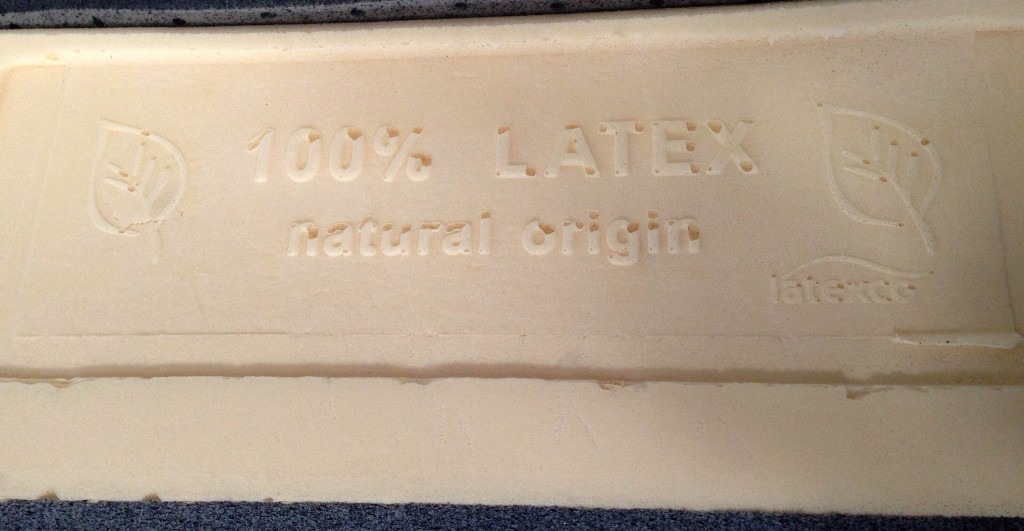
Usually there is only a handful of stamps per run or roll of latex foam this is to identify it from other blends. Once it has been cut into mattresses it can be hard to see quickly which blend it it. If in doubt always ask the retailer who should be able to tell you with confidence which blend it is. Not every mattress will contain this stamp, only those cut from the end of a roll the above image is an example of the end stamp used.
Organic Latex – Yet again there is another marketing spin on Latex with the ‘organic’ label piggybacking of the Natural Latex term. We would provide the following guidance when dealing with organic labels on Latex. We have yet to find any difference in material between 100% Natural Latex and Organic Latex. It is just a marketing tool to confuse and widen the market. We have already discussed how 100% Natural Latex is in reality 96% natural as other components are required. In the UK organic usually refers to pesticide free but again we have yet to find a supplier of Latex that will state this claim. We only refer to our Latex as 100% Natural and wont use the organic label due to the confusion it brings. Organic Latex is largely used as a description in the American bed market.
Innergetic Latex – A number of customers ask what blend Innergetic Latex is. The answer to this is simple. We have no idea. In fact no one within the Industry seems to be able to say either. This makes us dubious. There have been ‘whispers’ its a blend of Natural and ‘high quality’ synthetic Latex but we can’t confirm this. We know that Natural Latex is the premium product with the highest value, so it would follow that any Natural Latex would market itself as ‘Natural’. We don’t know what blend Innergetic Latex is but would hazard a guess its not 100% Natural. We will leave the rest up to you to decide!
100% Latex – This title again is very misleading. 100% Latex does not mean its 100% Natural. In fact it can mean the opposite 100% synthetic. You need to know the blend for the percentage value to have any meaning. 100% Latex is like arguing a bar of gold is 100% gold, you need to know the carat and rating as well!
100% Dunlopillo Latex – Again there is no clear explanation of what blend Dunlopillo’s Latex is. If it was Natural surely they would say? In the absence of any facts we would be cautious when trying to compare to an ‘unknown’ blend. An example of this would be if we labelled our Latex 100% John Ryan Latex. It wouldn’t tell you anything!
We also have more details latex as a comfort layer which is shown on our John Ryan By Design sister site.
Our Latex Range Below:




John
Hi
Do you have a showroom were I could try out you different latex beds.
I’ve tried the Dunlopillo Pegasus range & my wife would like a latex bed.
But spending such a relatively large amount on a bed I want to make sure we get the right one & check the differences in comparison to price.
Thanks
Hi John,
We don’t have showrooms as we are an internet only business. We do have a love it or return it 30 day guarantee which provides confidence that if the bed is not comfortable you can either return it for a full refund or do a one time exchange to a different model.
We offer all our customers advice on which mattress would be most suitable for them. If you could let us know your weights then we could confirm which latex mattress would be most recommended.
Our closest comparison to the Dunlopillo Pegasus is the Fusion 4 solid core latex model in 100% natural latex.
Any further questions just give us a call. Hope that helps.
Mrs Chidi
Hi there
I am looking to buy 2 beds and so glad to have come across your very informative website.
The first mattress requirement is a Double Mattress (4ft6) for a middle aged person. Preferable a firm supportive mattress for a restless sleeper, suffers from middle and upper back and neck pain and prone to allergies. He does sit up in bed a lot to read. Many decades ago he used and loved dunlopillo mattress so tending towards a latex mattress. Tried the dunlopillo in the shops and the universe range was probably the best as the others felt a bit too soft and too much of a sunken feel than he would like. Do not like the feel of memory form – too much of a squidgy cushioned feel and not as supportive as would like although like the comfort feel, but would wake up feeling rather crippled and disjointed after sleeping on them for a whole night. From this I believe the preference is really for the firmness of a high density mattress without necessarily being rock hard to avoid pressure soreness. And a bed that will last. Not really considered pocket spring due to bad experience with these in the past and concerned they will quickly develop back crippling and uncomfortable dips in them.
Having looked at your website I wonder if you agree that a Fusion 2 latex 80/20 would most suitable? Is there a noticeable difference between the Fusion 1 and 4 in sleep comfort and firmness?
Which one of your beds do you think would provide the required support and firmness with some cushioned softness as both seem to have removable toppers?
The user is about 180cm tall and. 95kg weight.
Can these mattress be used on a sprung slate bedframe?
The 2nd mattress is a Small Double (4ft) for more general use. For majority of the time will be used by young adult in early 20s, average height and weight (170cm and 70kg) who likes a medium to firm bed. The average user is unlikely to exceed 80kg. This bed needs to be versatile enough for a variety of people as it will be often used as a guest bed.
The Origins Pocket 1500 or Pocket Reflect 1000 look to be the only viable options although they are slightly over my max budget of £350.
Please let me know you recommendations for the 2 mattress needs.
What is your lead time for delivery to London?
Do you accept credit card payments?
I have one more question which I hope you can help with or shed some insights. I have seen in an online store an upholstered sprung slate bed frame I like very much but I really wanted an ottoman frame which this is not. According to the online description tere is about 30cm gap from the floor and the top of the slates so room for storage. I have also found online companies that sell hinges and gas pistons to be used to create an ottoman lift up bed frame. In your experience do you know if this is something that can be readily done? Is this something your company is able to help with?
Thanks and I look forward to hearing from you.
Ms Chidi
Hi Ms Chindi. For your first double mattress I’d recommend the fusion 2 or 4. The only difference is the blend of the latex with the fusion 2 being 80% natural and the fusion 4 being 100% natural. The more natural the more elastic the latex is so is slightly more progressive. The fusion 1 is a medium and would be noticeably softer than the firmer model. If you’re going to put it on a slatted bed frame we recommend boarding over the slats. There is a link here on how this can be done. If not the mattress over time can conform to the gaps in the slats and give the appearance of undulations.
For the guest room it depends on the average weights of your guests. As a rule the Origins 1500 is a more medium feel mattress and is ideally suited for this up to the 14-15 stone mark. If your guests are heavier then the Origins reflex is more suitable i.e. 18 stone. The Origins 1500 is usually better if children will also be using the mattress.
The lead time is round 4 week from the date of order to London, everything is hand made.
As for the gas struts and making a bed into an ottoman I wouldn’t recommend it. Unless you’re really handy it may be quite a lot of work to fit them correctly and you need to bare in mind the weight of a mattress i.e. around 60kg for a king size latex mattress and topper for example. We don’t sell ottoman mattresses only divans with drawers I’m afraid.
Hope that helps
Adrian
Hi,
I am interested in purchasing a mattress topper. We have had our current mattress for approx. 10yrs. It was bought with the bed frame which has a slatted base. The mattress is a DORLUX super king which states on the label that it has ‘over 1300 easyrest pocketed springs in a 150 king size mattress’ so presumably it has considerably more than 1300 pocketed springs.
I have suffered with lower back pain for years (probably about 25 years). I am 45yrs old and weigh approx. 11 1/2 stone. I am 5’8″. My wife is 5’6″ tall and approx. 9 1/2 stone. I generally find that my back pain decreases quite quickly after getting out of bed. I have no problem with lifting, exercising etc. and put my problem down to stiffening up at night.
I also don’t get much sleep at all. Generally I go to sleep very quickly (in a matter of a few minutes) and sleep soundly for about 3 to 4 hours if I’m lucky. I then basically toss and turn for the rest of the night. I don’t wake up fully and lie there thinking I could get up but go straight back off to sleep again but though I haven’t ever counted, it feels like I continue to repeat this process dozens of times through the remainder of the night until I get up.
I am a shift worker so this doesn’t help and strangely I don’t often feel really tired in the day as I don’t think I need the ‘traditional 8 hours’. However…on the odd occasion that I do sleep really well without the tossing and turning, I wake up feeling completely different i.e better!
We bought a mattress topper a year or so ago which is filled with a ‘spiral fibre filling’. It is made by Dorma. When we first put it on the bed it did feel incredibly comfortable. It has now compressed to the point of being useless apart from around the edges. Apart from being comfy, I can’t say it really made any significant difference to my sleep.
Subsequently, we were in the market for a completely new bed or mattress and to be honest if I could guarantee a regular good nights sleep I would pay as much as a decent car costs. However, I would rather have a decent car! I therefore want to be realistic about how much to spend on the bed / mattress / topper!
Having done a lot of research and resisted the urge to throttle quite a few bed salespeople, we have come to the conclusion (probably wrongly) that we do not yet need a new mattress. Though it is getting on a bit and has some discolouration it has virtually no signs of wear and only a very small indentation where we both lie. I guess this may be due to us both being quite light.
In view of this and reading through your website, we thought it might be best to try a really good quality topper first rather than getting a mattress and topper. The theory being that if the topper works…result for a while then replace the mattress in a year or two if necessary to give the best of both worlds.
I find our soft sofa far more comfortable than the bed and really don’t want a hard feeling topper so was shying away from the latex though it does sound good. I was coming down on the Laygel 7.5cm as the cool blue and laytex both sound like they may be more firm which I don’t think I’d bee keen on.
I am beginning to be convinced after all the research that my tossing and turning is a result of pressure after a few hours causing me discomfort and waking me. I sleep mostly on my side and sleep better when I’m on my back which seems to support this theory.
Apologies for the mega long sleep clinic style e-mail! Hopefully you can recommend what would be best i.e. which topper or a complete new mattress.
Hi Adrian,
Thanks for you enquiry. You have certainly done your research and the detail you have provided is really helpful so thanks for that.
A topper will never firm up a mattress, only soften the comfort later it so we can remove this worry from your search.
What I would say is that at 10 years old you mattress is considered for most mattresses as coming towards the end of its life in all honesty, that said we do advise if the mattress is still in good order and comfortable then theres no need to change it. I’d say given the horrific nights sleep your getting I really wouldn’t battle on with it, unless its budget restraints.
A topper will help soften the mattress some what but it does sound that for your weights its way to firm for you, hence the waking in pain and need to toss and turn.
If you are wanting to hedge your bets before a new mattress a lay gel topper will certainly add a softer top comfort layer, but won’t change the support of the mattress. Ie you can soften the comfort layer but the support will alway be firm. Latex will also help soften the mattress but given the firmness of your mattress I’d go with the softest topper we do 7.5cm lay gel. Our natural latex topper is a medium feel you see.
Ideally I’d say in time you will need to replace your mattress for something softer in support. The good news is you can match any of our toppers to our range so it won’t be a wasted investment. If you do have the budget I would urge you to consider a full mattress as your sleeping situation sounds awful Adrian. If you want suggestions for a new mattress can I ask you call us and we can help? Many thanks
Jonathan
Hi,
our current bed is a traditional firm king size bed, but gives me a bad back as a side sleeper, with the bedd offering little support in the dip between hips and shoulders. I’m also a ‘hot sleeper’ so am worried about going for anything hotter than a traditional wool filled mattress. We’ve been looking at a sealy santiago with geltech? I think? what would be your advice and equivalent product?
Thanks
Hi Jonathan, I’d need to know your weight to fully advise on which model is suitable. I can make some assumptions however. If you’re a hot sleeper I’d avoid memory and even hybrid foams as they are much warmer than say wool and natural fibres. I would however consider natural latex which is much cooler than say geltech, which is a kind of hybrid foam. If you can get back in touch with a weight we can advise fully, have a look at a fusion range as a place to start for latex mattresses. Lee
Felicity
Dear Sir/Madam
My husband and I have had a John Lewis latex mattress that we bought 9 years ago. (Barcelona model) It has always seemed a little too firm for us. My husband particularly, found that his frame (shoulder, hips) ached while lying on it. We tried out new mattresses in John Lewis and plumped for a king-sized 12,000 spring mattress from their natural collection range (a bargain at half price as an ex-display item at £750), it seemed so lovely and soft in the showroom and the high spec of the mattress reassured us we were getting a quality product. But after a week and a half of sleeping (or trying to sleep) on it has made us feel that it will have to go back. We find the new mattress hot and we are both waking with aching lower backs and we dislike the feeling of rolling together when we are too close. Consequently we have lost confidence in a sprung mattress and hanker for a cooler latex feel with support and no ‘roll-together’. Today we tried out the tempur mattresses in John Lewis and quite liked the feel of the Tempur 22 sensation deluxe model but I a wary of memory foam – worried that it might be hot to sleep in as well as a costly option.
My thoughts now are on reusing my old latex mattress – which seems in good condition still, with no noticeable sag and adding some sort of topper on it for comfort. I wondered what your advice would be on my options. Would a latex topper make any difference if we already find the latex too firm for us? Or do you think it better to try one of your other kinds of toppers to gain more softness?
For ref:
my weight 10 stone 10lbs, husband’s weight 13 stone 5lbs.
Yours faithfully
Felicity
Hi Felicity,
I’m sorry to hear you’re having a difficult nights sleep and struggling with your mattresses. In short it sounds like the mattress is simply too firm for you without the necessary comfort layers that you require for your weight.
I can’t find any detail on the John Lewis Barcelona in our archives but am guessing its not solid core latex, like our contemporary range. I’m assuming its a mix of pocket springs and a latex top layer making it a one sided mattress.
In terms of a topper it would add a softer top layer, especially using 100% natural medium density latex. It won’t completely transform the mattress but will soften and deepen the top comfort layers.
If you find yourself getting hot at night I’d avoid Tempur and memory foam. Latex is much cooler as its breathable but will still be warmer than say a traditional wool filled pocket sprung mattress. I’d say your best bet is to use a latex topper and see how you get on. If it is still too firm then maybe consider matching it with a solid core latex mattress, we have a number in our range. If you want to have a look at the specifications of our latex range have a look at the Fusion 3, this may help you compare the Barcelona and the new mattress you have. – Lee
Simone
Hello
We are interested in buying a latex super king mattress. My husband weighs 13 stone and I weigh 9 stone. I have a hip bursitis problem and my husband lower back problem. Can you please advise which of your mattresses would be best suited to us. We have recently returned from holiday in Spain and slept on a latex mattress, although only a rental property so it wouldn’t have been high end, and found it suited us.
Kind regards
Hi Simone,
Based on your weights I’d recommend a medium density latex. I don’t think anything firmer would be suitable, that said if you prefer a really firm mattress we do have some. You want something soft enough to mould to your profile but supportive enough to hold you there, especially if you have hip and back problems.
Our fusion 3 in a medium density 100% natural latex mattress. It is fully turnable and comes with a matching fully turnable 100% natural latex topper. It allows both sleepers to find their own comfortable sleeping position as its offers just enough sink before support. Thats the beauty of latex it can accommodate two different weights very easily. Theres also minimal transference i.e. bounce when someone rolls or moves in the night. The fusion 3 solid core latex mattress can be found here.
If you have further questions please just get in touch on 0161 945 3757 to speak to us. – Lee
John
How do you tell the difference between 80% + 20% synthetic & 100% natural latex
Hi John, The difference is in the amount of natural latex. To most people the feel and touch is only slightly different in that the 100% natural latex feels ever so slightly softer. Also the 100% natural latex is sometimes argued to have a slightly longer lifespan as its more pure.
That said 80% natural is usually way above the industry standard of 60% so when you’re getting to the percentages we supply in your already at the high end.
Hope that helps! Thanks – Lee
Lisanne
I am looking to buy a natural mattress for me and my partner as soon as possible. I definitely want to buy a natural mattress at a reasonable price, preferably organic.
I have found two different companies that sell natural mattresses and their prices are very good. I am not sure about their reputations and I am wondering if you can help me out.
First company is called Beds Direct Bentley. They sell a natural mattress using pocket springs and natural latex and wool fillings at £430. They also sell an organic mattress with a pocket unit using deep layers of organic wool. This mattress is covered in an organic cotton fabric which is important to me. It costs £770. Do you know anything about this company and its mattresses? Are they good quality? There’s not much information or photos of the mattresses on their website which makes them look suspicion.
Second company is called Dojo. Their low prices are impressive for 100% natural and organic mattresses. There are three options that looks good:
A medium feel mattress based on a deep core of 100% natural latex which is then wrapped in layers of organic wool. It costs £710.
http://www.dojoeco.co.uk/product/medium-natural-mattress
A firm/springy feel mattress with 10cm of 100% natural latex – two 5cm sheets either side of a 4cm core of coir (coconut fibre), then wrapped in layers of organic British wool. The outer cover fabric is a heavyweight organic cotton. It costs £695.
http://www.dojoeco.co.uk/product/medium-mattress
A firm to hard mattress where the latex is replaced by layers of organic wool. It costs £675, or £695 with pure latex instead of rubberised coir core.
http://www.dojoeco.co.uk/product/firm-mattress
I like a soft-medium mattress, but I do not like to sleep on a mattress that my body will sink into it, like a soft memory for. Is that the case with a Latex mattress? Or are there different types of latex that let bodies sink into it and others that does not?
Your 100% latex mattress (Fusion 100% Natural Latex Medium) in John Ryan contemporary shop is not organic, yet the price is higher than Dojo’s Latex mattress when they also use organic cotton cover and organic wool layers.
I was surprised by this because on the main and original website you kept saying that your prices are lower than similar mattresses by your competitors and you offer good value for money. Am I missing something? Can you compare the differences between your latex mattress and the latex mattress at Dojo?
Your Artisan Naturals mattress is more expensive than both natural pocket mattresses from Beds Direct Bentley, but like I said there is not much information on their website and there might be a good reason for their low prices. Maybe you know something about this company that you could tell me?
I am about 8 stone in weight and my partner is about 10 stone in weight. Please help me, I am struggling to choose a mattress! I also want to buy a topper for my new mattress.
Thanks for getting in touch and I can understand your request for company reviews. We will never make comment on another companies reputation unless impeccable like Savoir, its just not our style and we’re quite old fashioned in never gossiping! What we do is give you a clear list of our beds and components to let you compare and make your own mind up.
The sensation of latex will provide a slow progressive sinking feeling which based on your feedback would rule this out for a mattress option. If you really are set on latex I would definitely advise you go try some out in show rooms to get a feel for the sensation. The feel of latex is very different to a traditional pocket sprung mattress. We have some videos to show the response rate and reactions of foams which may help you to see how they behave.
The reason our latex is more expensive than those you have found is that our mattresses are significantly deeper than the models you have found Lisanne, and come with turnable matching toppers.
What you need to consider is the actual make up of a mattress. What I mean by this is that when say a company states a ‘Natural organic cover’, this in itself is meaningless without the GSM of the material or the depth and thickness. We are transparent with all our measurements and components.
I’d be wary of the organic label as well as its often confused with 100% organic, such as food items that are organic from seed, soil to harvest methods. Organic wool for example would only be fully organic if the sheep it was farmed from were fed only organic grass and seed, from organic soil and then treated with entirely pesticide and chemical free methods. As you can imagine there are very few farmers that would guarantee all their processing was entirely organic. Most are semi-organic.
Latex is sometimes labeled as organic, but in my experience unless the trees have been grown from scratch in organic certified soil then the label is very misleading. Latex trees take 7 years to cultivate before they can be harvested so any organic producer would have had to of set up organic soil and such and then wait for the trees to be ready to be harvested. I’m not saying there isn’t any organic latex out there, but theres no way it would be at the prices you’ve quoted I’m afraid!
The Artisan naturals is a fantastic mattress at 85% natural fibre with 1600 pocket springs which are hand formed in calico pockets possibly the best spring money can buy for a mattress. You would need to find details on the other mattresses you have seen to fully compare. It also comes with a 10 year warranty which I’m guessing the cheaper mattresses won’t offer or will offer on a proportional basis.
If you’ve found a good deal on a mattress Lisanne we would always advise that you take it. Just make sure you are happy with the composition and components of the mattress. Our site has a number of pages on latex and construction methods if you want to probe deeper to check. Lee
Comment Submitted Via Email
Hi
Have spent several hours reading your site today and am very impressed with the level of knowledge you have. We spent the afternoon in Dreams, Bensons, Feather and Black and our local high end department store and to be frank were entirely disappointed at the lack of expertise and limited information available about the beds we tried. I took great delight in Bensons explaining the different types of Latex to a sales assistant who told me he didn’t know much about technical specifications. I honestly felt I knew more than half the people we spoke to after doing my home work on your site! So thank you and we are now coming back to you for advice and hopefully a purchase.
We are a couple weighing 17 and 13 stone. My partner has 2 prolapsed discs-lower back and torn rotator cuff tendons in both shoulders resulting in shoulder and back pain, she prefers to sleep on her side. I have osteoarthritis in both hips which requires me to sleep on my side to stabilise my worst hip during sleep. We have a 10 year old silentnight orthopaedic bed which is beyond awful. We both suffer back pain that wakes us and often feel pretty awful after a nights sleep. It is definitely time we did something about it!
I suspect that we have in the past equated ‘firm’ support with ‘best for back pain’ but having read your site and others it would seem that a latex bed or latex topped pocket sprung option might be the best to relieve pain on pressure points. We were really taken this afternoon with the comfort factor of the latex topped beds we tried- Sealy and Hypnos but have come home and read awful reviews of Sealy beds and couldn’t afford the Hypnos examples.We were also told this afternoon that there was no such thing as an all latex bed-is this correct?
Can you advise us? We have a budget of about £1000.
Thanks for your email. It seems like you have encountered the mysterious and confusing world of retail beds!! I’m going to start at the end and work backwards if you will entertain it.
Firstly there is an all latex bed, these are called solid core latex mattresses and are the best type of ‘foam/contemporary’ bed you can buy. We have a full range of Fusion ‘solid core’ latex mattresses. What I believe the misinformed sales staff may mean is there is no 100% natural latex mattress, which is partially true. There is more detail here on this.. Dunlopillo offer solid core latex beds, but these are hard to find along with the exact blend of their latex which they don’t seem to state.
As for your current issues and mattress it sounds like you require a mattress that can offer both support but pressure reliving / comfort on certain points of the body. Latex is fantastic at doing this, it will give enough where pressure is placed and support those areas where needed. It offers what we term progressive comfort, ie just enough sink before support. This can sometimes be a different sensation compared to traditional pocket sprung beds. There’s a slight sink sensation before the support which is gradual. Since you’ve done your research and tried latex beds I’ll assume your comfortable with the sensation of latex.
The biggest decision is whether you prefer medium or firm, given your weights it maybe best to opt for the firmer mattress but with a medium topper. Meaning there is the soft comfort layer before support. If you both prefer a medium bed then the medium would be suitable. The heavier you get the softer the tensions will feel you see. Our fusion range comes in medium or firm and there is some weight guidance under each of these mattresses in our shop.
I would approach with caution any of the ‘latex’ beds you’ve mentioned as there are very few solid core latex beds in the retailers. A number of models are entirely synthetic and only contain thin layers with pocket spring units. Only Jensen that we know of at the moment come with removable turnable toppers similar to our range. What you need is deep layers or solid core latex to enable the pressure reliving and comfort to work properly.
I hope this helps, if you want to have a look at the range and then get back to me I can advise further. Lee